Vendor Return Authorization Processes in B2B Reverse Logistics
Mishandling B2B return authorizations costs millions in lost credits and supply chain disruptions.
Vendor return authorization is the gatekeeping system: it decides if a returned unit turns into recovered cash, and it decides if the unit instead becomes stranded inventory sitting in a warehouse aisle. In business-to-business reverse logistics, every unit that gets shipped back is supposed to map to a credit, and every credit is supposed to land in the books, but the process between those two points has more failure modes than most finance teams want to admit.
The dollar figures involved make the stakes plain. The global reverse logistics market is projected to reach $936 billion by 2026 according to Global Market Insights, and according to Grand View Research, B2B and commercial returns made up 35.1% of that market in 2024 according to Grand View Research, the single largest segment by return type. On the retail side, the NRF and Happy Returns found that retailers expected 15.8% of annual sales to come back as returns in 2025, totaling $849.9 billion. Consumer numbers like that get most of the attention, but the B2B side carries a different kind of risk. A single misrouted pallet, one shipment with the wrong size run, cracked packaging, the wrong product variant, or a missing accessory kit, can knock out an entire resale program or stall a production line waiting on components. The consumer return is a nuisance. The B2B return, handled badly, is a supply chain event.
RMA, RTV, and RTO: what each term means and where they fit in the B2B chain
Three acronyms do most of the work in this world, and they get mixed up constantly, even by people who work with them daily.
A Return Merchandise Authorization, sometimes called a Return Authorization or Return Goods Authorization, is the formal approval a merchant issues before a customer sends a product back. The RMA number ties the returned item to the original order, to the stated reason for the return, and to whatever resolution both sides agreed on: a refund, an exchange, store credit, or a repair. Issuing that RMA is the last real checkpoint in the cycle: it gives the vendor one final shot at diagnosing and fixing the customer's problem before the customer permanently gives up ownership of the item.
Return to Vendor, or RTV, is on the other side of that relationship. It describes the movement of goods from a retailer or brand back to the original supplier or manufacturer. Most conversations about returns default to the customer-facing side, the RMA world, but RTV is the supplier-facing mirror of it, and it runs on different triggers entirely: a defective unit where the supplier is at fault, a shipment damaged in transit, overstock or obsolete inventory being returned under a buyback agreement, or a formal product recall. A specific reverse-logistics category covers goods that never make it to the customer at all and get sent back to the shipping point, often because of a failed delivery attempt or a refused shipment.
Confusing these three terms is not just a semantic problem. Each one triggers a different financial and operational path, and coding a return under the wrong bucket is one of the quieter ways credit gets lost before anyone notices it is gone.
The authorization stage before a single unit moves
Everything that happens after authorization, meaning where the goods physically go, what condition they arrive in, and whether a credit is even recoverable, gets decided at the authorization stage itself. This is the moment where the paperwork either sets the return up to succeed or guarantees a dispute three weeks later.
A properly built RMA intake needs to capture the order number and SKU, the serial number or batch code, the stated reason for the return, customer and destination details, condition information, and the approved resolution (refund, exchange, repair, or credit); weak serial capture at this step is a reliable way to turn a clean return into a manual, email-chasing mess. None of these fields are optional in any meaningful sense. If the serial number is skipped at intake, someone in the warehouse ends up trying to reconstruct it from a packing slip three weeks later.
Before any of that gets approved, someone has to run a policy eligibility check: does the return fall inside the return window, does the product category allow it, does the purchase channel qualify, do the warranty terms cover it. That check also needs to sort condition correctly, distinguishing an unopened box from a lightly used unit, a damaged item, or one missing components, because each of those conditions leads to a different disposition once the product physically arrives. A well-built RMA form should have enough fields on it that warehouse staff aren't emailing back and forth to fill gaps, which cuts inspection time and prevents the wrong disposition call from getting made on a unit that deserved a different outcome.
Reason coding and how the codes drive downstream decisions
The reason code entered at authorization is, in effect, the decision about who pays. Marking a return as defective sends the cost recovery path toward the supplier. Code it as damaged in transit and the claim runs toward the carrier. Code it as overstock or slow-moving inventory and the whole thing gets governed by whatever buyback agreement is on file. Get the code wrong and the wrong party ends up disputing a bill they never should have seen.
The common categories in B2B returns break down into defective or quality-failure units where the supplier is at fault, damage that occurred in transit and belongs to a carrier claim, wrong-item or fulfillment errors, overstock and slow-moving inventory under buyback terms, and formal recalls. Knowing which trigger actually applies is what decides how the return gets coded in the first place, and that decision cascades through every step that follows.
Vague reason codes are one of the most common causes of supplier disputes in this entire chain. A code that just says "defective" with no further detail gives a supplier every reason to reject the claim outright, because there's nothing in the record that actually proves fault. Specificity at the point of coding isn't a bureaucratic nicety, it's the evidence base the whole credit depends on.
Physical return: transportation controls, inbound receiving, and inspection requirements
Once a return gets authorized, the product has to move with the same rigor as an outbound shipment, not less. That discipline tends to erode in practice, because everyone treats the outbound leg as the "real" shipment and the return leg as an afterthought.
Carrier, service level, pickup or drop-off method, and destination all need to be defined before the item ever leaves the dock. The return label or shipment record has to connect the parcel back to the original order, the return authorization number, and what the box is actually supposed to contain, because without that link, a receiving clerk on the other end is just guessing.
Packaging matters more on the return leg than most teams assume. A product that traveled outbound in a foam-lined, purpose-built box often goes back in whatever carton was lying around the returns desk, and that gap is where recoverable value quietly erodes: a unit that could have been resold at near-full value arrives crushed and drops into liquidation instead. High-value, fragile, oversized, or regulated products need routing instructions, tracking, and exception handling defined before the item ships, not worked out after a damage claim gets filed.
Financial reconciliation: issuing, tracking, and recovering credit notes, and where the money leaks
Most RTVs don't settle in cash. They settle as a credit note, where the supplier issues credit against future invoices and the retailer applies it to the next order, though some agreements allow for replacement units or repair instead. That structure works fine on paper. In practice, credit notes are where a huge amount of B2B reverse logistics value quietly disappears.
Missing evidence is the top reason credit notes stall out. A brand that captured photos and serial numbers at the intake stage has the documentation sitting ready to forward the moment a supplier asks for proof. A brand that didn't is now trying to reconstruct a paper trail for a unit that shipped out six weeks ago. Documentation not captured at the start gives the supplier grounds to dispute the claim, and this weak point appears in nearly every broken process. No tracking after the return ships means the credit note that eventually does arrive never gets matched back to the original return, and this second weak point is just as common.
ERP integration is where this either holds together or falls apart. The ERP needs to pull the unit out of sellable stock, open the supplier credit, and close that credit out the moment the credit note actually arrives. When that process is manual, and in a lot of mid-size operations it still is, units keep sitting in the system as available stock long after they've physically left the building. That distorts inventory counts and ties up cash that should already be back on the books.
Chargebacks and retailer deductions in vendor return authorization in major B2B relationships
Vendor return authorization doesn't operate in isolation. It sits directly inside the chargeback and deduction ecosystem, where retailers apply compliance deductions to a supplier's invoice whenever a shipment misses routing guide rules, whether that's a labeling error, an early or late delivery window, or a packaging spec violation.
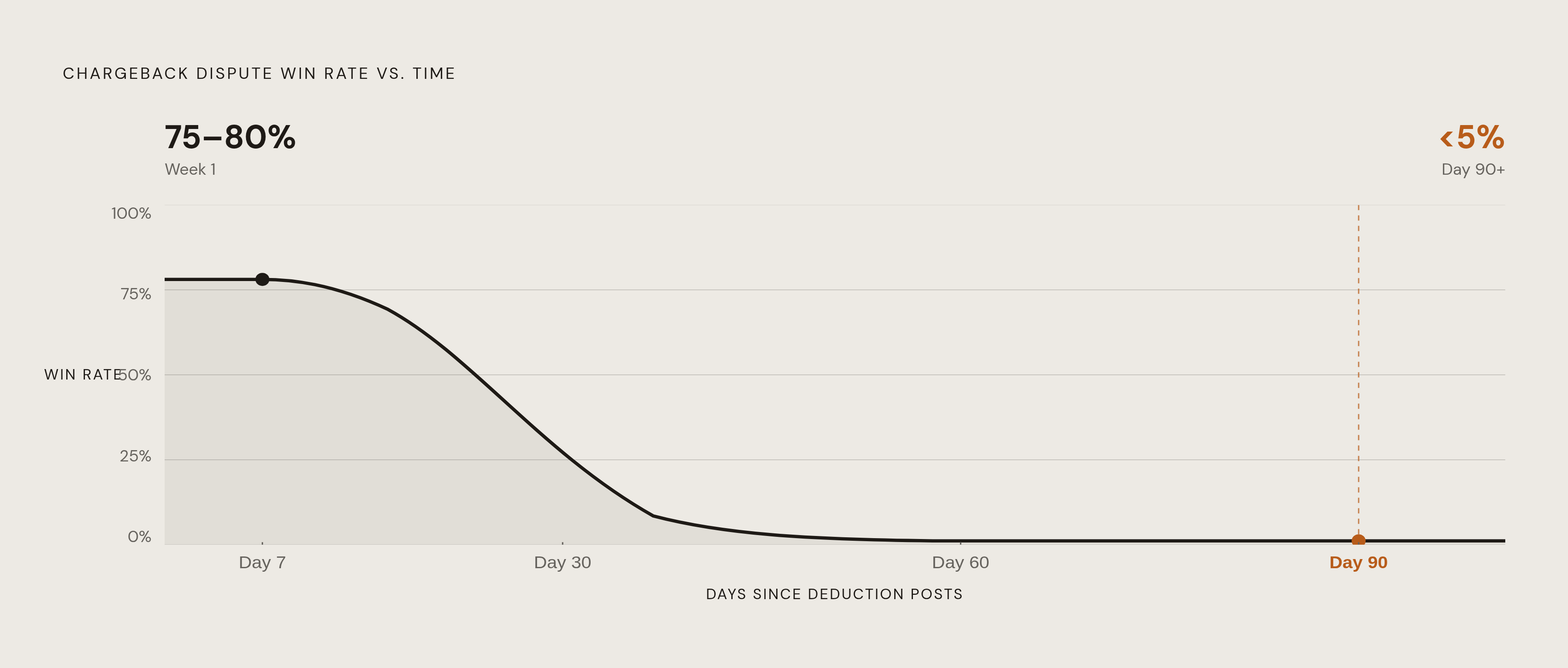
Timing is brutal here. Dispute win rates run 75 to 80% in the first week after a deduction posts, and they collapse to under 5% once 90 days have passed. That's not a gradual decline; it's a cliff, and it means a supplier's internal process for flagging and disputing deductions has to move fast or it might as well not exist.
Most suppliers don't move fast enough. On average, only 20 to 30% of deductions ever get disputed at all, even though an average 40% of disputed deductions get won back when someone actually files the paperwork. That gap, between what gets disputed and what could be won, represents real money sitting on the table. For vendors who aren't actively managing this, chargebacks typically run 1 to 5% of gross retail revenue, which on any meaningful volume is not a rounding error.
Why B2B authorization processes break down: operational and systems failures behind most lost credits
Most of the failure patterns in vendor returns repeat themselves across companies and industries, almost regardless of what's actually being shipped. Stock sits in the returns area with no authorization attached to it. It can never legally ship back to the supplier as a result. Credit notes arrive in someone's inbox and never get matched to the original return record. Defect reasons get logged as vague one-word entries, and suppliers dispute or simply ignore the claim because there's nothing in it to validate.
Systems fragmentation is the structural problem that produces those patterns, evident in what follows. Customer service tracks returns in one platform, the warehouse runs a completely separate system, finance calculates costs in a third tool, and dispatch is still working off a manual spreadsheet somewhere. None of those systems talk to each other in real time. Visibility is poor and decisions get made slowly when they get made.
Volume makes this worse, not better. B2B organizations place orders with suppliers as many as 420 times a day on average, and at that frequency, order errors and returns have been shown to cut profitability, efficiency, and productivity by 6 to 10%, and sales by 1 to 5%. Incomplete or incorrect RTV and RMA data isn't a paperwork inconvenience at that scale, it's a direct line to deductions, chargebacks, and revenue that never gets recovered.
Cross-border vendor returns: customs, duty reclaim, and the compliance layer most domestic processes ignore
Everything covered so far assumes a return moving within a single country's borders, where customs isn't a factor and duty was never paid. Cross-border vendor returns add an entire compliance layer that most domestic RMA and RTV processes were never built to handle.
A unit that crossed an international border on the way in, with duty paid at entry, doesn't just reverse that transaction automatically when it ships back to the supplier. Customs documentation, correct tariff classification, and proof of the original import are generally the difference between a business that can reclaim duty already paid and one that eats it as a sunk cost on top of the return itself. That compliance step sits entirely outside the reason coding, physical handling, and credit reconciliation work already described, and it's a layer a domestic-only returns process simply has no mechanism to address.
Sources
- Return to Vendor: The Complete RTV Process 2026
- How the Reverse Logistics Process Works: Step by Step
- B2B Returns Management and Reverse Logistics: A Practical Guide for Global Sellers - LooperBuy
- Return merchandise authorization - Wikipedia
- Return to Vendor: Meaning, Process & Retail RTV Guide
- A Guide to Reverse Logistics: How It Works, Types and Strategies | NetSuite
- What is return to vendor? RTV meaning & process | Red Stag Fulfillment
- claimlane.com