Cycle Time Benchmarks for E-Commerce Returns Processing
Breakdown of the five stages reveals which operations are truly slow and which ones just look it.
Returns processing runs through five distinct stages, and the number retailers usually quote (days from initiation to refund) hides which of those five stages is actually broken. An industry association and Happy Returns found that returned merchandise hit 15.8% of retail sales in 2025, or $849.9 billion, with online returns running closer to 19%. Neither figure tells an operator where in the pipeline the money is leaking. That is the gap this piece closes, stage by stage, and the biggest mistake in returns operations is treating a five-stage problem as a one-number problem.
What the end-to-end benchmarks tell you, and what they hide
Average full cycle time, from a customer clicking "start a return" to cash landing back in their account, runs 9 to 10 days. Best-in-class operations do it in 3 to 5. Operations still running manual review at every step take 7 to 14 business days, and plenty of mid-size retailers sit in that range without knowing it.
Set that against what shoppers actually expect. 85% want a refund inside a week. An operation averaging 9.5 days already sits outside what most of its own customers consider acceptable, before anyone even looks at the slow tail of the distribution. That gap has teeth: 52% of customers say they will file a chargeback when a merchant doesn't respond fast enough, and a chargeback compounds the financial damage well beyond the original refund amount. Cycle time is a financial control problem at that point, not just a satisfaction score.
Two retailers can both post a 9-day average and be running completely different operations, and this is where most people read the topline number wrong. One issues labels same-day and refunds same-day, but lets inspection sit for six days because the warehouse's inspection capacity can't keep pace with the volume. The other inspects within a day but holds every approved return in a manual refund queue for a week because a manual approval queue holds up every finalized return. Same number, opposite disease. Applying the first retailer's fix (more automation at intake) to the second retailer's problem (a stalled refund queue) spends the budget while nothing downstream changes. Chasing the average instead of the stage that's actually bleeding days is the single most common error in this business, and it survives because the average is the only number most dashboards show.
Stage 1 and 2: From return request to label in hand
The first two stages, initiation and label generation, belong entirely to the merchant. No carrier, no warehouse, no customer behavior determines how fast a label goes out. It runs on internal process alone, which also makes it the cheapest place to fix, and the fact that most retailers fix it last is a real failure of prioritization.
Automated operations get a label into the customer's hands the same day, or within 24 hours, with zero human review for anything that meets standard return criteria. Routing every return through a person for approval, including a plain size exchange on an inexpensive shirt, adds meaningful days of delay before the box has even left the customer's house. That failure mode appears constantly in mid-size retail, occurring before transit, before inspection, before any stage that's genuinely harder to control. It is the most wasteful kind of lag precisely because it is the most avoidable one.
The fix takes real systems work but isn't complicated in concept: auto-approve the standard cases and save manual review for the ones that actually need a human eye, high-value items, repeat claimants, return reason codes that look off. Most returns don't need a decision, they need a label. Treating every return like a judgment call, rather than the exception, is the mistake to fix first, before touching anything downstream.
Stage 3: Transit time, the stage you cannot speed up directly
Ground return shipping runs several business days depending on distance and carrier network, set by geography more than by anything a warehouse manager does. "Optimize harder" doesn't really apply here, because the merchant isn't moving the package. The carrier is.
That doesn't make the stage a black box. Carrier choice affects how fast returns move, since some networks consistently outperform others in specific regions, and drop-off infrastructure matters too: retail partner locations, package lockers, home pickup all shrink the dead time between label generation and the first carrier scan. Where a retailer routes returns, meaning which hub the label sends the package to, can cut real days off this leg if that hub sits closer to actual return volume instead of just closer to the primary distribution center.
The stronger reason to focus here has nothing to do with squeezing out speed. Transit sits outside direct control, so it is the stage to be honest about upfront with customers rather than promise against, and retailers who set expectations on this stage instead of trying to engineer around it end up with fewer support tickets, not fewer transit days.
A deeper cause produces this pattern directly: slow returns on short-lifecycle products cost real resale value while the box is still in a truck, as most operators miss the value argument buried in transit time. Research on returned consumer goods, conducted across Vanderbilt, Penn State, the University of Maryland, and INSEAD and published in Management Science, found that on short-lifecycle products, delays in the reverse supply chain destroyed more than 30% of product value before the item was ever inspected. The depreciation clock starts the moment the customer initiates the return, not when the box hits the warehouse dock. Transit time is inventory decay measured in days, dressed up in most retailers' reporting as a customer wait metric instead of what it actually is.
Stage 4: Inspection and grading, where most operations lose the most time
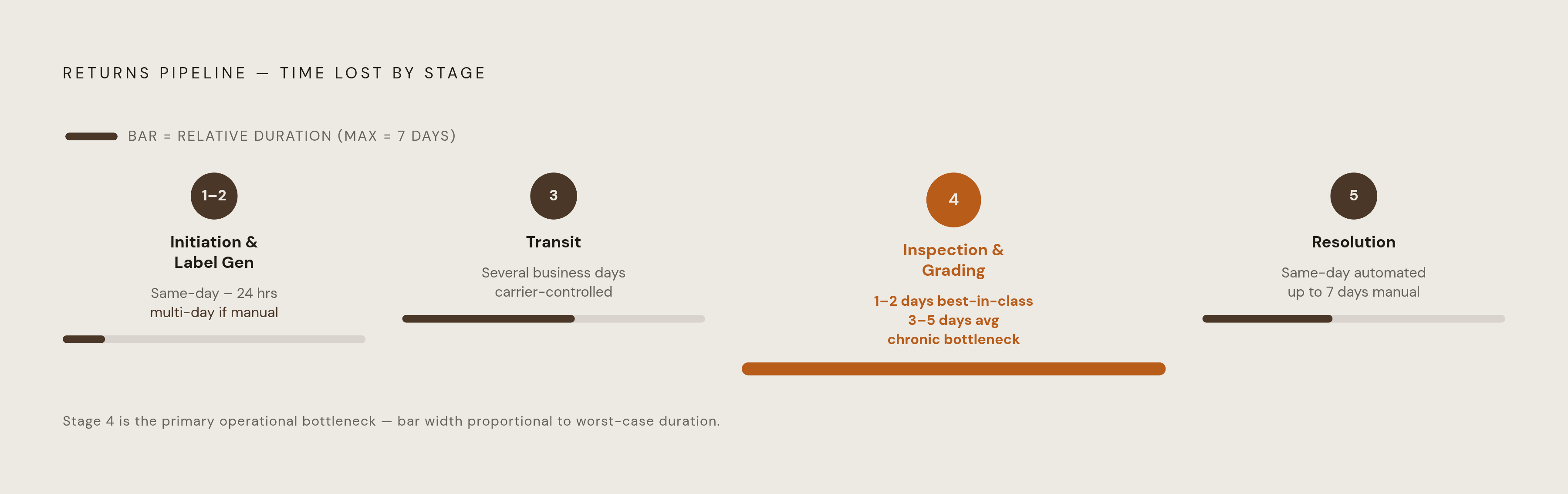
This is where the days go. Best-in-class warehouses complete inspection within 1 to 2 business days of receipt. Average operations run 3 to 5. Operations with a chronic bottleneck here run longer still, and the delay compounds, because inventory sits ungraded and unsellable the entire time.
The math at the unit level looks almost trivial: a trained worker takes 5 to 15 minutes to inspect a single return. At scale, throughput comes down to how many inspection stations exist and how many people staff them. A warehouse running four stations through a holiday-volume surge doesn't get faster because the workers hustle harder. It gets faster because someone adds stations or shifts, and no amount of individual effort substitutes for that math.
January is the tell. Processing times balloon every January because the same inspection capacity built for normal weekly volume now has to absorb the holiday-return surge on top of it. The bottleneck almost never lives in how the workflow gets designed, it lives in how much capacity exists to run that workflow at peak. Mistaking a capacity problem for a process problem is how retailers end up rebuilding a workflow that was never actually broken.
Best-in-class warehouses grade with a four-tier framework, and the tier a returned item lands in determines almost everything downstream: resale channel, margin recovery, how fast it re-enters sellable inventory. New and pristine, Grade A items come with original packaging and no visible damage, and go back out for resale. Grade B resells at a discount after repackaging, usually for minor cosmetic wear. Grade C, functional but carrying real wear or damage, goes to liquidation. Grade D gets written off entirely, either not salvageable or not worth the cost to restore. The grading decision itself takes minutes. The queue to get graded is what costs days, and that distinction, queue depth versus grading speed, is what most operators get backwards when they blame the grading step for a bottleneck that's actually about how many items are waiting in line.
Stage 5: Resolution, the moment the customer feels the cycle time
Everything upstream stays invisible to the customer. Resolution is the only stage they actually experience, and automated operations issue a decision same-day once inspection wraps. Manual approval workflows add meaningful delay on top of that, and that overhead only earns its keep for high-value or flagged cases, never for a routine return that already cleared inspection clean.
Refund timing still depends on the payment rail that carries it. Processing takes 1 to 7 business days after the return is finalized, depending on the payment method and the customer's bank. Credit card refunds typically move slower than store credit or a digital wallet credit, and that's a banking-system constraint, not a merchant one.
Resolution doesn't have to mean cash back, either. Exchange-first flows and store credit keep the revenue inside the business instead of sending it back out the door. Refund rate is the share of returns that leave as cash rather than credit or exchange, and it moves more easily than return rate itself, tying more directly to margin. A retailer that can't reduce how often people return things can still reduce how much of that value walks out the door as cash, and that's the lever to pull first.
The stakes here are retention. 71% of consumers say a bad returns experience makes them less likely to shop with that retailer again. Resolution speed is where that repeat-purchase decision actually gets made, quietly, without the customer ever framing it that way to themselves.
Measuring each stage rather than just the total
None of the stage-level detail above does any good without instrumentation. That means timestamping every handoff separately: label generation, carrier scan, warehouse receipt, inspection completion, refund issuance. Not just initiation and resolution. The five points in between are where the diagnosis actually lives, and skipping them is why so many retailers keep fixing the wrong stage year after year.
Stage-level timestamps surface patterns an end-to-end average can't. A warehouse that receives packages quickly but inspects slowly has a labor or workflow bottleneck sitting on the inspection floor. A warehouse that inspects fast but holds approved returns in a refund queue has a systems or approval bottleneck sitting downstream, in a different department entirely, needing a different fix. An operation where label generation alone takes 48 hours for a standard case has an automation gap right at the front door, before the package has even shipped.
Corso's 2026 stage benchmarks work well as a reference line for this kind of audit: same-day label generation, 1 to 2 days for inspection at best-in-class operations, same-day resolution once inspection closes out. Wherever measured time exceeds that benchmark is the stage to fix first, and it is rarely the stage a retailer assumes going in.
Category changes the math, and ignoring that is its own error. Electronics need functional testing, which takes longer and runs $30 to $65 per unit versus a quick visual check on apparel. Benchmark comparisons only mean something within a category. Comparing electronics inspection time against apparel inspection time is an apples-to-oranges error dressed up as data, and this error survives inside a company for years because nobody checks the category mix before pulling the benchmark.
Where automation and platform choices move the needle
Automation doesn't help evenly across all five stages. It concentrates at three: initiation and label generation, inspection and grading, and resolution, all of which sit inside the merchant's direct operational control. Transit doesn't belong on that list, since the carrier controls it, not the retailer. Spending automation budget on the three stages a retailer actually owns is where the return is visible. Spending it anywhere else is money aimed at a lever nobody's hand is on.
At stage 1 and 2, automated label generation removes the manual review delay for standard cases entirely, because there is no review left to wait on. At stage 4, AI-assisted inspection and grading compresses the check-in-to-graded-decision window to 24 to 48 hours at automated operations, and per-unit labor costs fall meaningfully in the process. At stage 5, automated disposition logic issues a resolution the same day inspection finishes for routine cases: no queue, no sign-off delay.
McKinsey's 2025 research found that a substantial majority of standard returns qualify for straight-through processing. Most volume, by sheer count, should never need a human to look at it at any stage. That's a stronger claim than automation being nice to have: it means most of the volume moving through a manual review process today gets reviewed for no reason.
The aggregate numbers back this up. Returns management software has been shown to deliver processing 50% faster while increasing revenue retention, and the broader shift to automated workflows compounds those gains across the full pipeline. Retailers running one automated returns platform report cost reductions of $3 to $8 per unit, and 30 to 40% lower per-unit processing costs overall, depending on scale and category.
None of that argues for automating everything indiscriminately, and treating it as a blanket mandate misses the actual lesson here. The case is for automating the stages genuinely inside a retailer's control, and measuring each one separately, so the fix lands on the stage that's actually broken instead of the one that's easiest to talk about in a quarterly review.
Sources
- 30 Ecommerce return and refund statistics (2026)
- Returns Processing Speed Benchmarks for Brands | Corso
- Return Processing Times: Benchmarks & How to Speed Up
- Returns Management Process: What It Is and How to Manage It
- Ecommerce Returns Management: The Complete 2026 Guide
- returnpro.com
- opensend.com
- eurosaleonline.com